Friday, March 12, 2010

Traversing the Province of Abra (Part 1)

Welcome to Bangued, Abra!


Leaving the office a few minutes after 9 a.m. last March 1, my officemate Perry Galario and I along with OMB driver Bert Dancel set course on a journey to the rugged northern province of Abra. After several stopovers including lunch at Sison, Pangasinan and a brief respite and merienda at Perry’s home town of Candon, Ilocus Sur, we finally arrived half past six at the Municipality of Bangued, the capital of Abra.


Weeks before, our acting director had asked me to join Perry who will be conducting field research regarding empowerment of selected non-government organizations (NGOs) involved in monitoring of government project. NGOs identified in several provinces were all coalition partners of the Northern Luzon Coalition for Good Governance (NLCGG). I obliged, despite our (the RSSB staff) serious questions on current recognition and appraisal of work assignments at the bureau. I knew this was a work challenge I couldn’t pass up. More so, it will give me the opportunity to renew ties with old anti-corruption colleagues in Abra and have a first hand experience of what they have been doing for over two decades now.


And a challenging adventure it proved to be! Fortunately, the exhausting day long 400+ kilometer drive was tempered by my thrill of numerous first time sights.


Our simple but functional accommodations at the Diocesan Pastoral Center


Our friends at the Concerned Citizens of Abra for Good Governance (CCAGG), one of NLCGG’s pioneer member organizations, initially made reservations at a cooperative managed facility for our accommodations but we had inadvertently discovered a cheaper alternative at the nearby Diocesan Pastoral Center. As we would soon find out, the Pastoral Center was just across the street from the CCAGG office.


That night was the first of several exploratory hikes we made around the rustic poblacion of Bangued. We ate dinner at a neighborhood eatery chain locals generally call the “Fastfood”.


There, one encounters the exotic viands of Ilocandia, a mix of meats often including pork and goat (Kaldereta), their innards (Papaitan) sometimes not surprisingly raw (Kilawin). I am not that adventurous, sticking mainly to the rich sour stews and salty condiments they bathe fresh vegetables in. “Diningding” and “Pinakbet” or simply steam vegetables with fish bagoong poured over them, now that’s my kind of Ilocano food!


Foreign participants on a study tour are welcomed at the CCAGG office


Off to work the following day, we went to the CCAGG office that morning located at the 2nd floor of the DZPA building in Rizal corner Zamora Street.

New unfamiliar but warm faces greeted us at the CCAGG office. Some were on-the-job (OJT) students while the others were younger generations of CCAGG volunteers. I was informed that some of the people I knew before were either out of the office or have long gone for other pursuits.


With CCAGG offices and staff with 2 DPWH officials


With CCAGG staff and volunteers


Soon after we were joined by foreign NGO delegates here in the country for a public procurement related training. As part of their training, they were given an orientation by Ms. Pura Sumangil, a founding leader of both the CCAGG and NLCGG. The foreign delegation included representatives from India, Mexico and South Africa. During the briefing, we experienced a minor earthquake whose epicenter was estimated to be somewhere in nearby Cagayan province under Region 2. Nothing like a mild tremor to spice your day around!


Ms. Pura Sumangil of CCAGG/NLCGG gives an orientation


While the foreign delegates were being interviewed over the local radio station, I took time to take pictures of the countryside near the top floor of the DZPA building.

Abra is a landlocked province hemmed between the mountain ranges of the Ilocos provinces to the west and the Cordillera mountains to its east. Part of the Cordillera Autonomous Region or CAR, it covers roughly a fifth of the region’s land area, easily making it the largest province in that locality. Mostly descendants of Ilocano settlers and members of the Tingguian tribe, residents of the province numbered more than 230,000 according to a 2007 population survey.
Not part of any regular sightseeing brochure, Abra is no where to be found in the Arroyo government’s so-called “Philippine Tourism Highway”. Its history of political violence and warlordism doesn’t help change that. Rather, it shuns away tourist and possible investors that could bring greater development to its people.

That’s the great tragedy. As I soon discovered during our stay in this province, relatively devoid of the decadence and degradation that accompanies unbridled commercial development of a locality, agriculturally-based Abra remained quite the unspoiled paradise it has been for so many years. Much of the area within its 27 municipalities has remained the same…as if time had stood still.

Sadly, unscrupulous politicians, bureaucrats and businessmen have exploited Abra’s poverty and rugged terrain for their illicit enrichment. Civil works like bridges across the great Abra River supposedly to promote progress and development into the province ended up incomplete and utterly useless. Corruption was definitely pervasive across Abra’s political landscape. This led to the creation of the CCAGG in 1986 and as they say, the rest is history.


Bangued is nestled in a valley between the majestic mountains of Abra


A simple sumptuous lunch is served!


After lunch, we accompanied the foreign delegates to the first government civil works site we were to observe CCAGG’s project monitoring activities. Located around five (5) kilometers from the town proper, we inspected the on-going bridge construction in Barangay Calaba and adjacent Barangay Modeng of the municipality of La Paz.


The Calaba Bridge up close and personal


Nearly a kilometer in length, the Calaba bridge is finally near its completion


The construction of the Calaba bridge and approaches were funded through national government funds with financial assistance from the Austrian government. It was supposed to have been completed (based on the DPWH’s own target date) mid-August of last year, but for decades that has been the sad story for many of the bridges in Abra.


People, goods and vehicles are ferried across the great Abra river


Engr. Rene Brasuela of CCAGG inspects the on-going construction


All in a day’s work!


Friday, December 4, 2009

Happy 12th Anniversary, Starbucks Philippines!

Happy 12th Anniversary, Starbucks Philippines!


I don’t exactly remember when I first heard of or got hooked to the so-called “Starbucks coffeehouse experience”. But my earliest recollection of having drunk their product was in the late 90’s.

Back then, I used to write as a contributing editor to a rather academic publication called the Sanggunian: The Philippine Local Government Journal. Its office was along Tomas Morato Avenue near the corner of Timog Avenue. On many occasions as I would go there to submit my articles, they would often serve some merienda like Hen Lin dimsum or tasty éclair pastries with (you guessed it right!) classy Starbucks coffee. Albert C. Lim, editor in chief of the Sanggunian would proudly tell me in the local vernacular, “Pare, simple lang ang merienda natin. Pero Starbucks ang kape naming dito!” (Bro, the snack we serve here is quite simple. But the coffee we serve comes from Starbucks!)

And so that was my early impressions of Starbucks, a tasty but nevertheless, expensive upscale glorification of the common man’s drink. I grew up drinking instant coffee from diamond shape encrusted Nescafe glasses. There was a time that I liked black coffee so much I think I consumed around 6-8 glasses of coffee a day! I eventually shifted back to colas when one day I saw my chest quite uncontrollably palpitating.


So through the years, I considerably lost my penchant for coffee. Starbucks, you might say, in a way revived my interest for what many still considered simply a working man’s beverage by raising the quality standards for its products and providing a totally new drinking experience to share and enjoy!


Family bonding at the SM Mall of Asia Starbucks branch
(Dec. 2006)


Initially, I think I spent more money collecting the shop’s coffee mugs and tumblers than on the coffee itself, drawn to their elegant and yet functional designs worthy to be part of my personal collection.

This time around my Starbucks experience is often shared with the whole family, as new and youthful generations of serious coffee drinkers like my children are set to emerge.


Chilling out at the FEU Hospital Starbucks branch in Fairview after attending an evening Mass at the Good Shepherd Parish (June 2007)


So it wasn’t just the excellent coffee or the mugs and tumblers that I collect, or their wonderful planners I use every year or the ambiance, or the soothing music or the friendly baristas or the countless moments of family bonding that makes me come back….and back all over again to this coffee brand. Rather, it’s the synergy of it all that makes that distinctive Starbucks experience that makes me want to come back and experience it all over again.


Everybody in my family loves a Frappuccino! (Trinoma - November 2009)


Congratulations Starbucks on your 12th year in the Philippines!

May you continue to brew excellent coffee covered with the warmth of that unique Starbucks experience!


Friday, October 9, 2009

A foggy family outing in Baguio (Part 2)


There was a cool 17°- 22° Celsius temperature all through out our four - day outing in
Baguio City. The increment weather had invariably brought an enveloping fog across the city. We savor to view this panoramic sight as the presence of this intense mist only adds up to Baguio’s mystic beauty.


Invariable heavy fog covers Baguio


We were set to originally go back to Manila today but we decided to stay for another day considering the reported impassability of certain roads back to the National Capital Region.


Junior checks out the hotel’s Gretsch drum set


Having our complimentary Continental breakfasts


We visit the designer restaurant 'Bliss Cafe'


Our morning wanderings brought Junior, Sonny and I to Bliss Café located at the ground floor of the hotel. Into their sixth year of “blending veggie food, art & music into a fine science”, we didn’t have the opportunity to try out their dishes but reviews claim that the “awesome” vegetarian dishes prepared by owners Jim and Shanti Ward don’t taste like vegetables! Now that’s something even my carnivorous children will surely be pleased about!


The place is adorned with oriental works of art


A colorful gecko hangs from the ceiling


Sonny Boy meditates seeking enlightenment


My daughter’s silhouette next to Baguio’s heavy fog


My family goes around the hotel


On a tight budget, we had to stay overnight somewhere else. But before we finally left the hotel, my family spent some time to go around the place. Something we weren’t really able to do since we arrived.


Between the fireplace and a pastoral themed fresco


The hotel’s Mediterranean style is said to be the brainchild of famous interior designer Tess Prieto


Hotel Elizabeth’s beautiful garden pavilions


With so much more to offer, Hotel Elizabeth is surely a place I would like to return to in the future. Probably a bit pricey for the budget conscious Filipino family on vacation, I would rather recommend it for those who have the resources and/or for those who are saving for those very special occasions.

Overall rating for Hotel Elizabeth: 3 and a half out of five stars


Speaking of the budget conscious traveler, my family transferred to Mile-Hi Inn inside Camp John Hay.

“Clean, cozy and comfy.” That’s how Mile-Hi Inn described itself in its leaflet. I believe that was an honest self assessment. Their standard rooms are tidy and very practical. Similar rooms (Forest view room) that face the back of the Inn have a picturesque view of the camp’s forested area. Both types of room can accommodate three to four people though there is ample space for additional people in a room. Note however that there are additional charges for extra persons and extra beds in a room.

We got a forest view room which had a queen-sized bed and a double-decker. Since we were there during the off-peak season, we were also able to avail of the 50% percent discount on room rates.

Situated at the heart of the Camp, the Inn is minutes away from many famous Baguio tourist spots. Dining establishments are also numerous inside the Camp so feeding your hungry kids won’t be a problem.


Back for lunch at family favorite Chocolate de Batirol


Our extended stay gave us much time to leisurely go around as Baguio should be experienced slowly --- not in a hurry.


Welcome to the Philippine Military Academy


First time to this Marian grotto inside the Academy


Another first visit: PMA’s St. Ignatius Chapel


Inside the PMA’s large cafeteria


The Lopez Hall of Leaders building


“Constructum eduro” (Built to last)

Built by the Lopez Group Foundation, Inc., the Lopez Hall of Leaders is said to be “dedicated to the past, present and future cadets of the Philippine Military Academy.”


Souvenirs from this PMA visit included two refrigerator magnets and a cool sweater I bought at the commissary area.

Convenience and a diminishing budget led us to a regular dinner at the McDonald’s branch at Hotel Veniz. After which we came back to our room at Mile-Hi Inn.

We didn’t want to leave the Camp without visiting another Baguio favorite, the local Starbuck’s branch located on the road going to the Golf Clubhouse. So that night, with one small flashlight, the boys and I braved the near impenetrable night fog to feel that unique Starbucks -Camp John Hay experience!

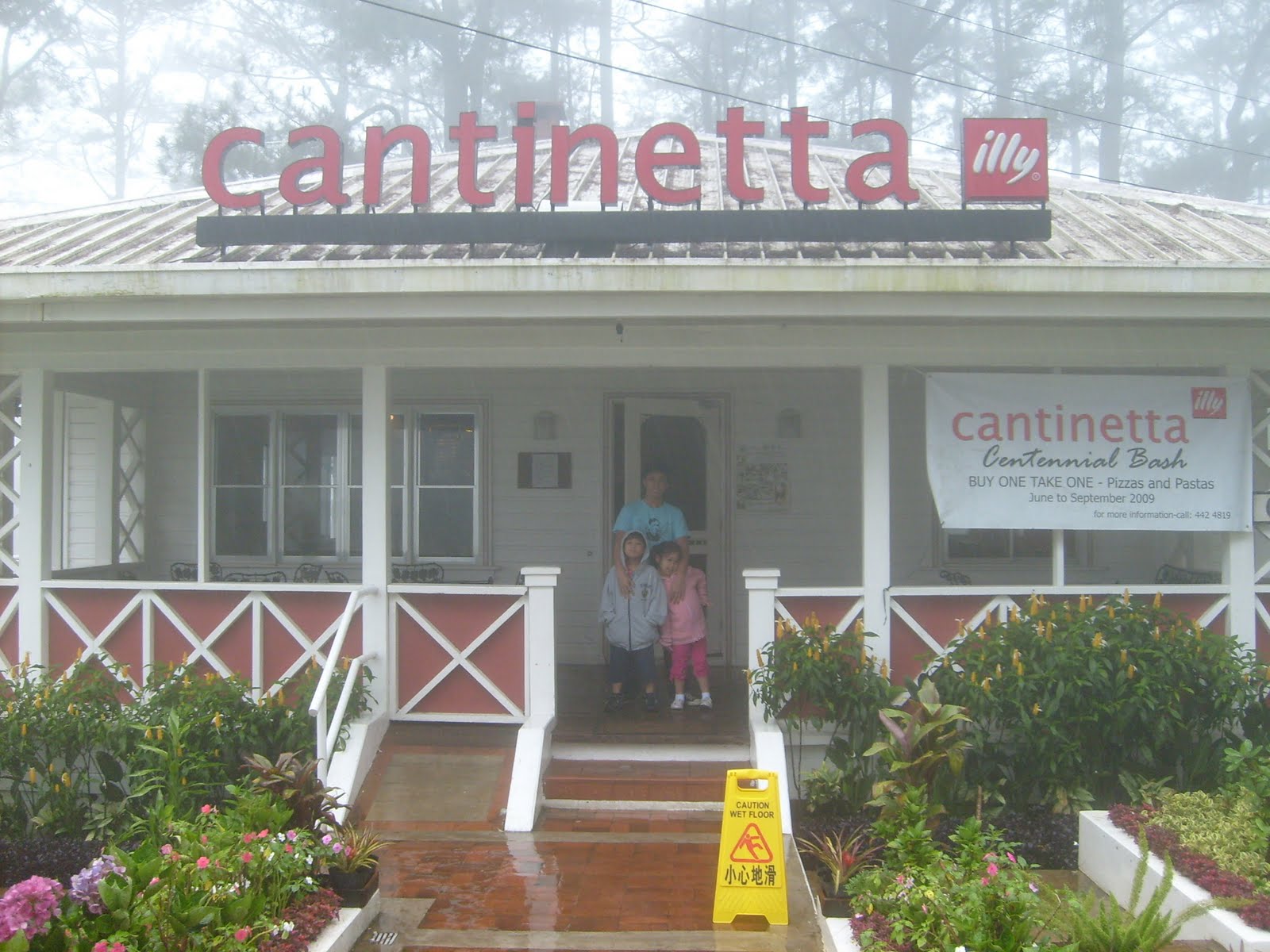
Before going back, we also passed by the adjacent Italian Restaurant named Cantinetta. I noticed their streamer announcing a “Centennial Bash” promo where you can get a buy one take one pasta and/or pizza deal from June to September. Something I look forward to relish with my family tomorrow.


A room with a view: Inside the Mile Hi Inn


The forest view outside….


...with a dense fog that never seems to lift


Good morning, Joshua!


Small room but comfy


Overall rating for Mile-Hi Inn: Three (3) out of five (5) stars


A pleasant breakfast at “….everything nice”


The early morning fog remains to engulf the Camp quite beautifully if I may say so. To complement the stunning ambiance is the wonderful breakfast meals we ate at the “Everything Nice Cakeshop and Café. Personally, I highly recommend one tries their longganisa meals (try the garlic version).


Hard to beat delicious longganisa meal


Joshua opts for an equally tasty corned beef meal


Not really a water drinker, I just loved their cold refreshing water! Then I realized their secret, mint leaves are put in every water pitcher which accounts for its extra taste of freshness!


Faith and Joshua in pajamas - my family enjoys the cozy environment


From cakes to longganisa, there’s something good for everyone at “…everything nice”


Italian lunch food at Cantinetta


Pushing through with my goal last night, my family later had a sumptuous lunch at the Cantinetta Restaurant inside Camp John Hay.


Everywhere you look reminds you of Italia!


Family pictures at the Cantinetta


Joshua and Faith pose


Wine….


…and more wine bottles!


The reserved sign in the picture above reminded me of the restaurant’s manager story that Freddie Roach, Manny Pacquiao’s coach and trainer and company recently ate there. While Pacquiao trains in Baguio, I’m not surprised if they would go back to this place again and again because of its delicious Italian food.


Finally…the pizzas arrive!


We ordered three different pizzas.

First was the Quattro Formaggi a thin crust pizza topped with four classic Italian cheeses – ricotta, mozzarella, gorgonzola and parmesan. The second was the Cantinetta Classica, a pizza with Italian sausage, pepperoni and minced beef. The third was the Romagna Pizza covered with anchovies, olives and capers (which we got another pizza because of the promo). The Quattro Formaggi quickly disappeared with the Cantinetta Classica a close second. The Romagna didn’t get obliterated early as my family members weren’t much into anchovies, olives and capers as much as I was.


We tried out several pasta cooking too!


The different pasta we ordered was also equally delectable. We had servings of Pesto Mare (fresh seafood tossed in pesto sauce), Fettucini Alfredo (pasta in cream sauce), Contadina (Italian sausage with mushrooms in tomato sauce) and Aglio Olio e Peperoncino (pasta with extra virgin oil, chili and garlic sauce).


Panna cota - traditional Italian desert


For dessert, we treated ourselves to spoonfuls of Panna Cotta, a light, silky custard pie very much like our Filipino leche flan.

Kudos to the manager/patron of Cantinetta-CJH, Ms. Nanette Filler for her warm hospitality and friendly service during our short but pleasant stay in the restaurant.

Overall rating for Cantinetta-CJH: Four stars out of five


We’ll be back at Cantinetta!


The presidential white Mansion seemed to “vanish in the haze”


Our final wanderings around Baguio brought us to the Presidential Mansion, the Good Shepherd Convent and to the food stalls of Camp Seven.


Family portrait at the Good Shepherd’s view deck


Welcome to the garden of St. Mary Euphrasia Pelletier (Foundress of the Good Shepherd Sisters)


One should never leave Baguio without tasting the famous food products of the Good Shepherd Convent’s Mountain Maid Training and Development Foundation store near the Mines View Park. Famous products include their strawberry jam, lengua de gato and peanut brittle products. But my personal favorites include their finely textured ube jam and exotic blueberry jam.

Aside from enjoying their delicious food products, one would feel good by the fact that every time you buy from the foundation, you help their working students earn a decent living while earning a useful form of vocational education.

After buying pasalubong from the Good Shepherd Convent and from the Camp Seven stalls, we start the long way back home via Kennon Road.

The stormy weather and the knowledge of the widespread havoc Typhoon Ondoy has spread over the country may have somewhat dampened our Baguio-loving mood. But there is always sunshine after the rains. Baguio remains a special happy place for my family.

We look forward again to rediscovering Baguio the next time we come back.


Goodbye misty Baguio…’til next time!